
The White Shirt Worth Keeping

There are clothes bought with enthusiasm and forgotten within a year, and there are clothes that slowly become part of a person. A white shirt belongs to the second group when it is right, and to the first, more often than most of us admit, when it is not.
Owning a white shirt is not the same as owning one you reach for. The second kind is familiar. You know how far the sleeves push up before you push them, how the collar has softened, how the cotton feels after a great many washes. It may have a faint crease at the elbow that ironing never quite removes, and a button that does not quite match the others. It is rarely the newest shirt in the wardrobe, or the most expensive. Often it is the opposite.
The question underneath it is a plain one: what actually makes a white shirt worth keeping? The answer has less to do with the label than with fabric, construction, proportion, fit, opacity and laundering, and most of all with whether you genuinely want to wear it.
What Makes a White Shirt Worth Keeping?
"White shirt" describes a category rather than a single garment. It covers crisp poplin, soft Oxford cloth, linen that has never met an iron, silk that drapes like a blouse, and men's shirts found secondhand. What they share is a colour, and very little else, which is why the search for a quality white shirt so often goes wrong. People shop for the colour and forget the garment.
A good classic white shirt has qualities you can test. It is comfortable after several hours, not only in the fitting room. It sits properly at the shoulders and has enough ease to move in. It holds its shape, washes well, and works with the clothes you already own. It looks good slightly rumpled as well as freshly pressed, because at some point in the day it will be rumpled. And you reach for it repeatedly, which matters more than any of the others.
That is the difference between a shirt that photographs well and a shirt that lives well. The first is judged in a single frame: pressed, arranged, flattering. The second is judged over a year, on trains and in kitchens, under jumpers, in and out of the wash. Plenty of shirts do the first job beautifully and fail at the second.
Longevity is not only physical, either. A shirt can survive a decade in a drawer and still be a failure if you never wear it. The white shirt is called a wardrobe essential so often that the phrase has stopped meaning anything. The real measure is simpler: does it become part of your life?
Start With the Fabric
The white cotton shirt is the reference point, and a women's white shirt is very often some version of it, but cotton covers a lot of ground. Fabric decides how a shirt hangs, how it creases, how it feels in August and how it ages. Different fabrics solve different wardrobe problems, and none is better in every case.
Cotton poplin
Poplin is tightly woven, with a smooth surface and a crisp look. Run a hand over it and it feels almost cool and flat. A white poplin shirt gives a clean, fairly structured line, sits well under tailoring, and tends to read as more formal. It can crease in sharper, finer lines than softer weaves and often looks best pressed.
Oxford cotton
Oxford cloth shows more of its weave and is usually a little heavier and more textured than poplin, with a slightly nubbly surface you can feel. A white Oxford shirt has a relaxed, traditional character and suits everyday wear. Depending on the weave and the finish, it can become especially good with age and washing, softening at the collar and cuffs while keeping some body.
Linen
Linen breathes, and its natural, slightly irregular texture suits warm weather. It wrinkles, and the wrinkles are part of its character, so it should never be sold to you as wrinkle-free. A white linen shirt is usually the most relaxed of the group, and the one most at home worn loose on a hot day.
Silk
Silk is fluid where poplin is crisp. It has a different sheen and drape, closer to a blouse than to a traditional cotton button-down, and it usually needs more careful laundering. It is not interchangeable with cotton in look or in care, and is best chosen for what it is rather than as a softer version of the same shirt.
Cotton blends and stretch fabrics
Blends and stretch cottons can add comfort, movement or easier care. The trade-off is that stretch may change how a shirt holds its structure and how it feels over time. Read the fibre composition on the label instead of assuming quality from the branding or the price.

The Details That Tell You Whether a Shirt Is Well Made
No single detail proves a shirt is well made, but together they show whether someone thought about how it would be worn.
The collar and cuffs
Look at the collar's proportion against your neck and face, and whether it has enough body to sit under a jacket or knit, or is soft enough to lie open. Stiff and soft both have uses. What matters is that it does the job you want. Cuffs deserve the same attention: a substantial finish, buttons placed so the sleeve sits properly at the wrist, and a length that suits the way you wear it. Collars and cuffs are often where a shirt shows wear first.
The buttons and seams
Buttons should be firmly attached, evenly spaced and free of pulling across the front. Their material does not prove quality, but a spare button, often stitched inside the placket or hem, suggests the shirt was expected to be kept. On the seams, look for small, even stitching and neat finishing inside, especially at the side seams and armholes, where most of the strain falls.
The placket and hem
The placket, the strip down the front that carries the buttons, affects how the shirt hangs and how cleanly it closes. It should lie flat, whether it is a standard placket, a concealed one or a shorter half placket. Try the hem tucked, untucked and open, and see how it meets the waistband of your trousers or jeans. The shape of the hem affects how the shirt behaves tucked and untucked. A curved hem can sit neatly inside trousers, while a straighter hem can give a cleaner line when worn out, but the proportions of the whole shirt matter more than the hem shape alone.
Opacity
A white shirt can be beautiful and still impractical if it is unexpectedly sheer. Check the density of the fabric, whether it is lined or double-layered anywhere, and how it behaves in daylight rather than under shop lighting. Try it over the underwear you actually wear; skin-toned pieces often show less under white than white ones do. Opacity is part of choosing the garment.
Fit Matters More Than the Label
The right size can still be the wrong shape. Fit is less about the number on the tag than about how the shirt is meant to sit.
A tailored white shirt is cut closer through the body, with the shoulder seam at the edge of the shoulder and the sleeve ending near the wrist. It suits trousers, tailoring, professional dressing and cleaner proportions. In a white button-down shirt for women, watch the buttons across the bust: they should lie flat without gaping when you raise your arms.
A relaxed white shirt has more room and a softer line. It suits jeans, everyday wear and layering, and it is comfortable with the sleeves rolled or the front left open.
An oversized white shirt works with denim, relaxed trousers and skirts, and gives the deliberately borrowed-shirt feeling many people are after. A men's or vintage shirt can supply longer sleeves, broader shoulders, a longer body and more volume. But it still has to work with your proportions.
Oversized is not simply buying three sizes too large. Look at where the shoulder seam falls: a dropped shoulder should look chosen, not accidental. Look at the sleeves, which should end at a length you can live with or roll on purpose. Check the body length against your trousers or skirt, and the scale of the collar against your frame. A tailor can often shorten sleeves and take in side seams, but shoulders are much harder to change.
In the fitting room, raise your arms, sit down, cross them, roll the sleeves, tuck the shirt in and pull it out again. A good white button-up shirt for women should survive all of it.
The White Shirt You Will Actually Wear
Fabric and construction only take you so far. The rest is your own life.
Which trousers do you already own? Do you mostly wear jeans? Do you need a shirt to sit under jackets, or one to wear open over everything? Will you iron it? Does it need to travel? Do you want it crisp or relaxed? Do you live somewhere hot? How often do you wash, and would you rather have a shirt that improves with washing or one that stays polished?
The answers change what you should look for. If you live in jeans, a relaxed Oxford or a softer poplin may serve you better than a stiff, tailored one. If it goes under jackets, choose a collar and cuffs that lie flat and a body that will not bunch at the waist. If you will never iron, be honest about it, and lean towards fabrics that forgive creasing or are meant to wrinkle. If it is hot for most of the year, weight and breathability matter more than a sharp collar.
Choose the shirt for your actual life, not the life represented by the photograph on the retailer's website. A beautiful shirt that needs an elaborate routine you will never keep up is not necessarily the right one, however good it looks. In a small wardrobe, a white shirt has to work with almost everything else, and a capsule wardrobe built around fabric, fit and construction starts from the same question of what actually goes together.
How to Style a White Shirt Without Making It Feel Like a Uniform
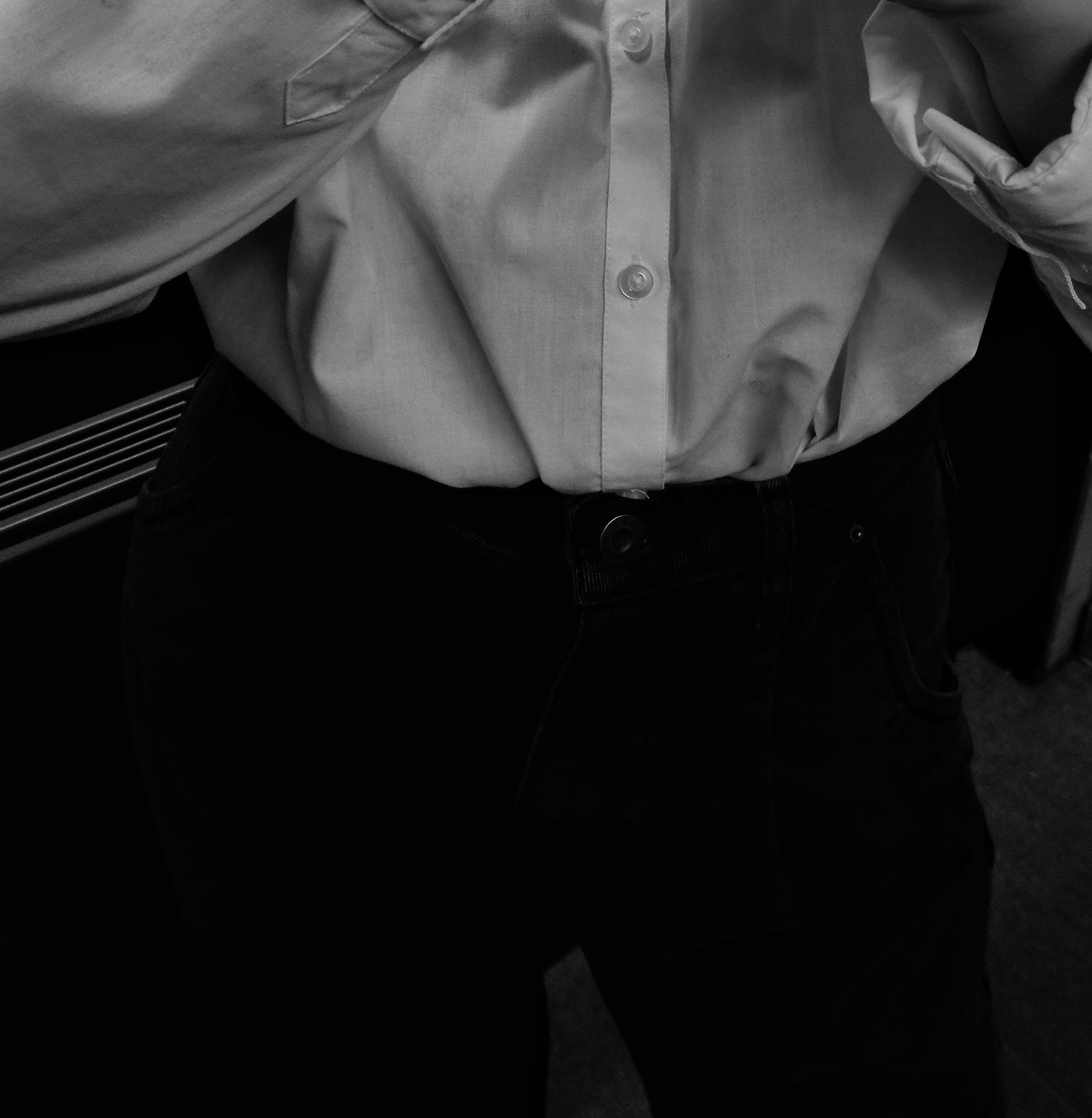
Knowing how to style a white shirt is mostly a matter of what you leave alone. A shirt that has been worn a great deal rarely needs much done to it.
With vintage jeans. The easiest pairing is worn denim. The particular faded blue of a pair of vintage Levi's against white cotton needs nothing added. Tucked, half-tucked or hanging loose, with the cuffs turned back, it looks lived in from the first wear.
With tailored trousers. Tucked in, collar open, with plain shoes. A knit over the shoulders or a jacket on top makes it last through a longer day, and the shirt keeps the whole outfit from feeling severe.
Under knitwear. Let the collar and cuffs show. White against navy, grey, brown or black turns the shirt into a quiet foundation, doing its work at the neck and wrist. A collar folded neatly over a crew or V neck is often all the finish it needs.
With a skirt. Tucked or loose, sleeves rolled. Masculine shirting against a feminine silhouette is a familiar combination, and it holds when neither side is overplayed.
Worn open. Over a simple tank or a dress, or over a swimsuit at the beach, with the shirt left to move as you do.
On its own. Unbuttoned at the neck, sleeves rolled to the forearm, and worn without much thought. Relaxed reads better here than over-styled.
The Beauty of a Shirt That Has Been Worn
The best white shirt is not necessarily the one that looks newest. It is the one whose shape you know before you put it on.
Cotton softens with wear and washing, though not every fabric does and not every wash helps. Collars lose their edge. Creases settle where the elbows bend and the waist folds. A button has been replaced and the thread is a slightly different white. A faint shadow appears at the cuff. None of this is failure. It is the evidence that a garment has been lived in.
There is a line, of course, between damage and character. A collar softened by years of washing is character; a collar frayed through is damage. A mended button is character; a seam that has split along the shoulder is a construction problem, and no amount of sentiment fixes it. A good shirt should survive use, but it should not have to stay pristine to stay beautiful. Something kept only for best never gets the chance to soften, which is the argument of The Things We Keep for Best: that good things earn their place by being used.
A wardrobe should hold things that become more familiar rather than things that are constantly replaced. A white shirt is one of the easiest places to start.
How to Wash and Care for a White Shirt
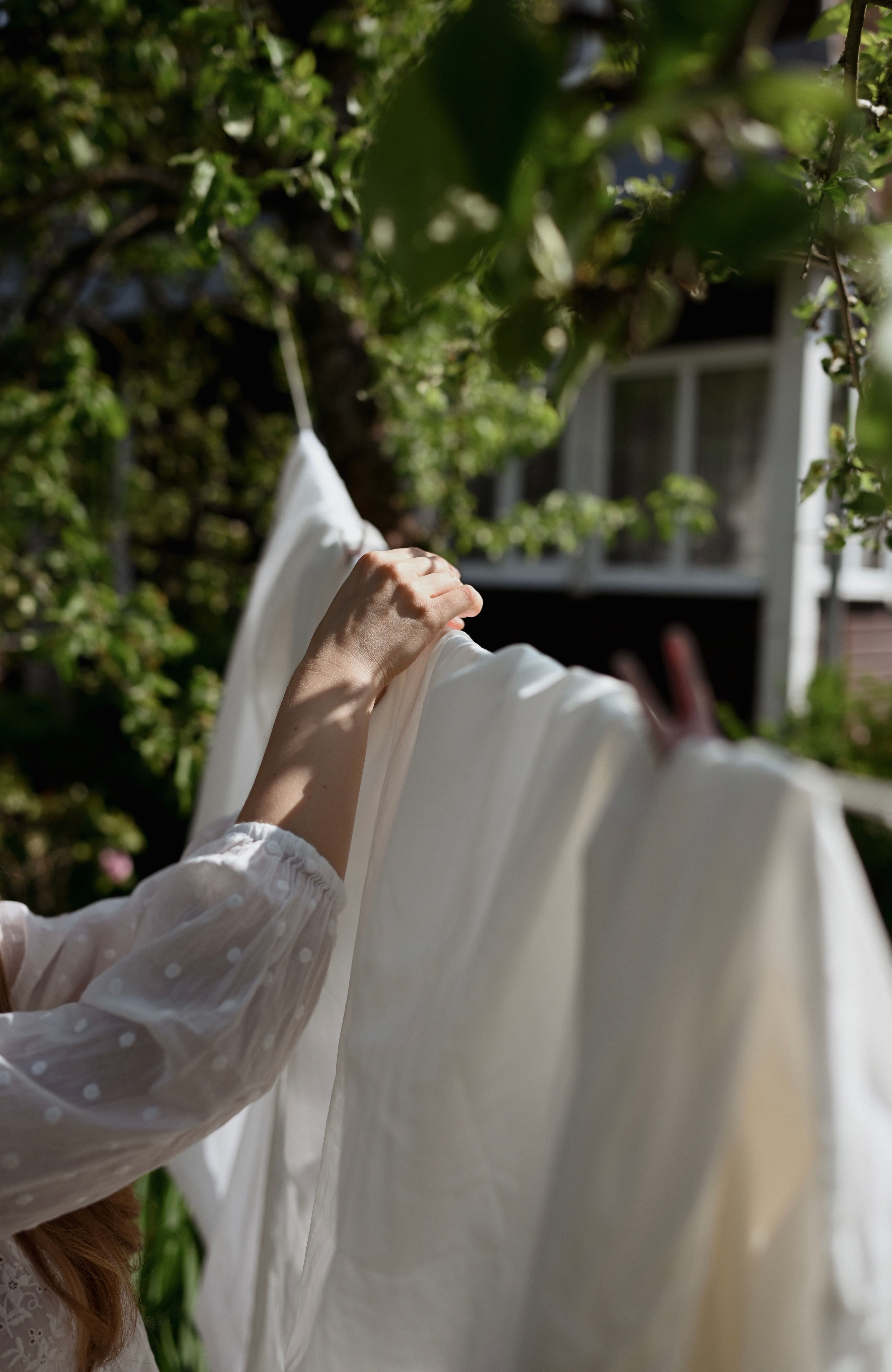
Follow the care label first. Depending on the fabric, the right temperature, cycle and drying method can differ considerably.
In general, wash whites with whites, and avoid harsher treatment than the shirt needs: an overloaded machine, more detergent than necessary, or hot water where the label does not call for it. Check the label before using bleach or a strong stain remover, since some fabrics, silk in particular, can be damaged by them. Treat marks promptly, before a hot wash or the dryer can set them.
Some cotton shirts shrink in a hot dryer, and drying on a hanger or line is usually gentler. Cotton is often easiest to iron while slightly damp, and a steamer can refresh a shirt without pressing it flat. Linen will wrinkle however you treat it, and that is expected. Silk can need very different care, often gentle handwashing or professional cleaning, so read its label closely.
Store shirts on a broad hanger or folded with room around them. Replace a loose button before it is lost, and repair small problems, a seam starting to open or a frayed cuff edge, before they become large ones. A tailor can sometimes turn a worn collar or replace a cuff.
Care is part of ownership. It is what turns a shirt you bought into one you have.
Should You Buy a New White Shirt at All?
Start with what you already have. Look in your own wardrobe, in vintage shops and charity or op shops, in men's shirting, on secondhand marketplaces and in family wardrobes. Secondhand is not automatically better, but it often comes already softened, and the shirt you are looking for may already be hanging at the back of your own cupboard, or may once have belonged to someone else in the family.
An existing shirt may need very little: a new button, better laundering, a different way of wearing it, sleeves altered or one small repair. It is worth trying those before deciding it has failed.
Buying new makes sense when the current shirt no longer fits, the fabric has worn through, the construction has failed, there is a genuine gap in the wardrobe, or the shirt you own does not suit the way you live. Those are good reasons. Boredom with a shirt you have hardly worn is a weaker one. When you do buy, take the questions above with you: the fabric, the details, the fit, and the life the shirt has to fit into.
The White Shirt Worth Keeping
The point is not to find the ideal white shirt for women, if such a thing exists. It is to find one that fits your life, works with what you own, feels good after hours of wear, survives washing, can be repaired and becomes familiar.
Somewhere between the shirt bought with enthusiasm and the one that slowly becomes part of a person lies a long run of ordinary days. A shirt gets there through repetition: the same cuffs turned back to the same place, the same collar worn open by the second button. Its edges soften. Its faults become known, and forgiven.
A white shirt is at its best when it stops feeling like a wardrobe essential and starts feeling like your shirt.
Keep this one
Save it to Pinterest.
Share this story
Things worth noticing
A note from Twenty Acres, occasionally. New stories, beautiful things, and the details we're keeping.