
Why Vintage Levi's Get Better With Age

Some Clothes Are Meant to Be Worn
Some clothes become more interesting the longer they are worn.
A new pair of jeans is stiff, evenly dark and still slightly anonymous. It hasn't learned anything about the person wearing it yet. Over time, the denim begins to change: pale at the knees, softer across the seat, lighter along the seams. Creases settle where the body bends, the hem takes on the shape of the way it is walked in, and the blue becomes something more individual.
That is part of the pleasure of old Levi's. A good vintage pair can be more interesting to look at than it ever was new, not simply because of the cut or the details, but because of everything that has happened to it since.
The best wear isn't decoration. It is evidence of use — years of sitting, walking, reaching, washing and living in the same piece of clothing. No two pairs end up quite the same, because no two people wear them in quite the same way.
Why Denim Changes With Time
Denim is a working fabric, and it records what it's put through. In traditionally dyed denim, indigo sits mostly on the outside of the cotton yarn rather than soaking through it, which leaves a paler core. Friction wears away the surface colour, and the lighter cotton underneath begins to show.
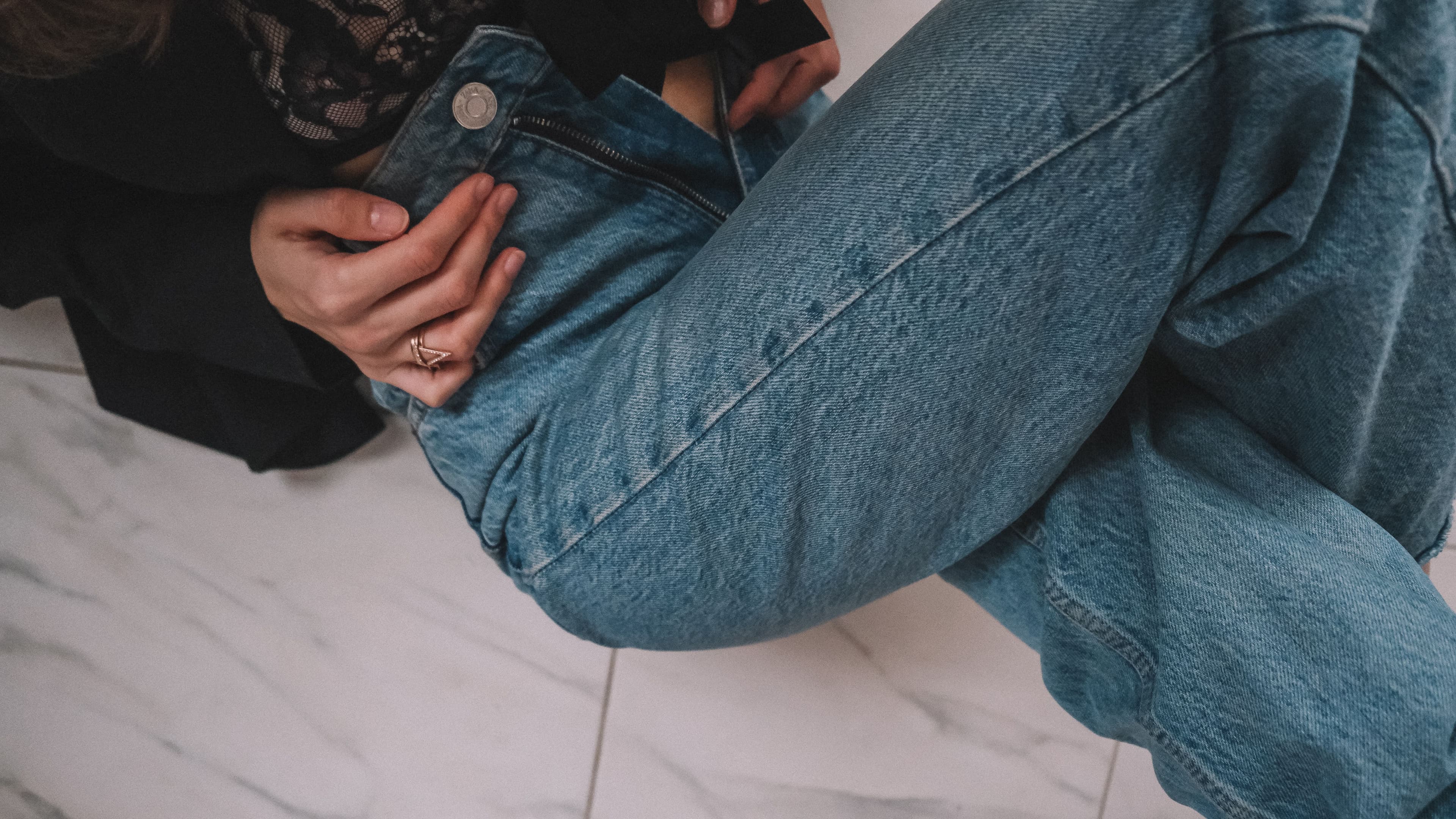
Where the friction happens depends on how someone lives in the jeans. Creases across the lap and hips fade into what denim people call whiskers. The honeycomb patterns behind the knees come from bending, and stacks gather at the hem. A wallet, a set of keys or a habit of pushing the hands into the pockets leaves a mark of its own. Two people can wear identical jeans for ten years and end up with two different pairs.
The fabric changes as well as the colour. Stiff twill loosens, the leg begins to hang differently, and the knees and seat take on the shape of the body moving inside them.
None of this is simply damage, and not all of it is beautiful. Wear is a record of use, and whether it's a flattering record is a separate question. Part of the pleasure of vintage is choosing the pair where it has happened well.
The 501 Was Made to Last
Levi's begins with a practical problem. In 1872 Jacob Davis, a tailor in Reno, Nevada, wrote to Levi Strauss, the San Francisco dry goods merchant who supplied his cloth. Davis had found a way to stop work trousers tearing at their weakest points: he riveted them, at the corners of the pockets and the base of the fly. He couldn't afford the patent fees, so he suggested Strauss pay them and share the patent. It was granted to both men on 20 May 1873.
The trousers were sold as waist overalls, for people whose work was hard on clothes. Around 1890, when the rivet patent expired, Levi's began giving its products lot numbers, and the riveted waist overall became the 501. The company doesn't know why that number was chosen. Its records were lost in the 1906 earthquake and fire.
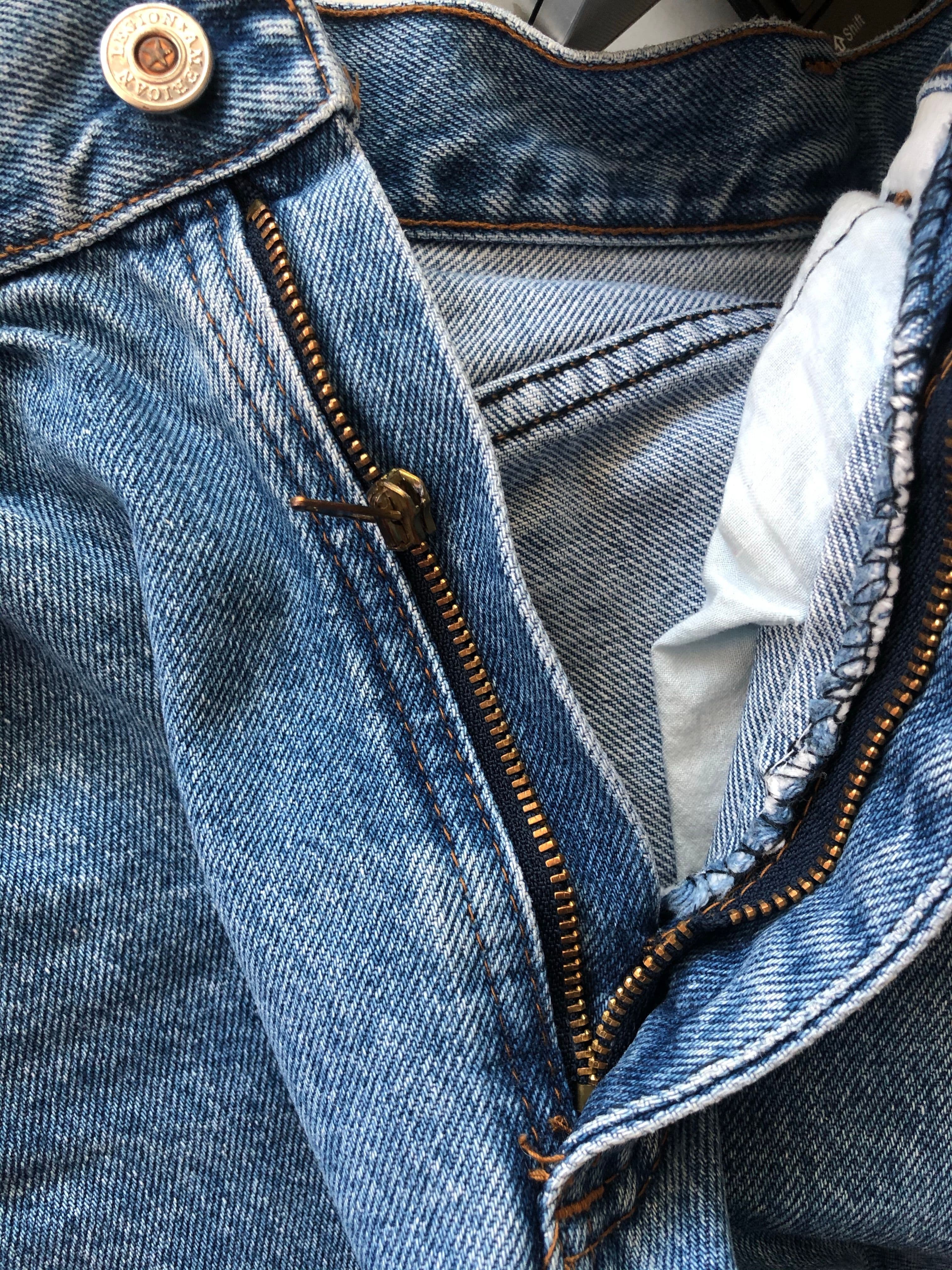
The rest arrived slowly, mostly in response to customers and competitors. A second back pocket appeared around 1901, giving the five pockets jeans still have. Belt loops came in 1922. The red tab was added in 1936 so that Levi's could be told apart from imitators using similar stitching, and the rivets on the back pockets were covered the following year after complaints that they scratched furniture and saddles. The button fly was there from the start. The zip version, the 501Z, wasn't introduced until 1954, for customers unfamiliar with buttons.
None of this is romantic. It's the history of a garment being adjusted, patiently, until it worked, which is a large part of why so many pairs have lasted long enough to be worn in.
The Beauty of Real Wear
A new pair of jeans can be made to look worn. It can be sanded, washed, whiskered and scuffed at the factory until it resembles a pair with ten years behind it. There's nothing dishonest in that, and some of it is done well. But the wear is applied, so it's the same on every pair in the size run.
Genuine wear isn't applied. It accumulates, unevenly and for reasons. The knees soften first. The thighs pale where the fabric has creased and unfolded thousands of times. Seams lighten where they take the strain, pockets crease into the shape of whatever lives in them, and the hem wears to a soft, slightly ragged edge where it has met the ground. The board-like stiffness of a new pair has gone, and what replaces it moves with the body instead of resisting it.
Broken-in jeans of this kind can't be reproduced, because what makes them individual is that nobody chose it. The wear belongs to whoever did the wearing.
Wear is only lovely while the fabric underneath is sound, though. A pair worn to gauze at the inner thigh is at the end of its working life. The best worn-in denim is soft but still substantial: faded, not failing.
Vintage, Not Distressed
"Old" and "made to look old" are different things, and you can feel the difference before you can explain it. A distressed pair is styled to suggest a past. A vintage pair has one, even if the details are unknowable: someone else's habits, a season of use, sometimes a re-stitched hem or a patch of thread that doesn't quite match.
Some of what looks like age is also factory finishing. Many jeans sold from the 1980s onwards were already washed, or stonewashed, before they reached a shop, so a vintage pair is often a mixture of the two. Part of the pleasure is reading which is which.
None of this makes vintage better across the board. New jeans are consistent in sizing and condition, and some are very well made. Plenty of old pairs are simply tired. The claim is smaller than that: a pair that has really been worn has an individuality that can't be ordered, and for some people that is the whole point.
.jpg&w=3840&q=75)
What Makes Vintage Levi's Feel Special?
Mostly it's small things, noticed slowly.
The fabric. Levi's own tailor advises vintage shoppers to skip stretch denim, on the grounds that traditional fabrics hold up better over time and wear into a good fade. Older, non-stretch denim softens rather than sags, and it fits closer to the body than modern jeans do.
The details. The lettering on the red tab, the patch at the back waistband, the number stamped on the back of the top button, the colour of the thread. The tab is a good example. Until 1971 the word was stitched in capitals; after that only the L stayed capital, and collectors have been talking about "Big E" and "little e" ever since. On many pairs the stamp on the top button identifies the factory that made them.
The eras. The cut changed as well as the details. The 501 has had many variations in fit over its history, which is why two pairs with the same number and different decades behind them can feel quite unlike each other. Collectors generally place the end of selvedge 501s, with their finished woven edge along the outseam, in the mid-1980s.
A note on dating. These details help place a pair, but none is conclusive on its own. Patches wear off, hems are replaced, factories overlapped for years, and even the specialist guides describe themselves as collector research with exceptions. Treat each detail as a clue.
The traces. A mended knee, a slightly wavy waistband, a hem taken up for someone else's legs. These aren't flaws by default. They're how a pair passes through hands.
The 501 Is Famous. It Isn't the Only Pair Worth Finding.
Say vintage Levi's and most people picture the Levi's 501. That's understandable: it's the oldest, the best documented, and the one collectors usually mean. But the 501 is one cut among many. Levi's own tailor describes it as a straight leg with a button fly, and notes that although it began as a men's fit it has become more unisex. The 505 has a similar cut with a zip fly and a more relaxed thigh.
The 550 is a useful example. Levi's introduced it in 1985 as a relaxed fit, with extra room throughout and a slight taper at the leg. Set beside a 501 it has a different character. The straight line becomes a fuller one that narrows toward the hem, so the jeans sit, fall and pair with other things differently.
That isn't a ranking. A 550 is neither a better jean than a 501 nor a lesser one. Different cuts work on different bodies and with different wardrobes, and the most famous model isn't necessarily the one that gets worn most. The pair that becomes yours is often not the one you set out to find. It might carry an unfamiliar number, an unusual proportion, or a fade you didn't know you wanted.
The right pair is the one whose shape, denim, wear and proportions make you want to put it on again.
The 90s Made a Strong Case for Levi's
The 90s understood that good jeans didn't need much. Early in the decade, plainness had become a kind of good judgement: a recession and a reaction against the excess of the 1980s had pushed fashion toward pared-back silhouettes and neutral colour. Straight and relaxed jeans slipped into that easily. They were worn with a white shirt, a plain knit, loafers or ballet flats, and not much else. The outfit deferred to the denim instead of competing with it.
The appetite for old Levi's was already there. Levi's own timeline records that in 1992 the company introduced its Capital E jean in the United States because of worldwide consumer interest in vintage pairs, following a vintage-style model made earlier by Levi Strauss Japan.
The same restraint ran through the decade's beauty habits, and it's the part worth keeping. Not the costume, but the idea that a few good things, worn often, were enough.
How to Wear Vintage Levi's Now
Old denim sits best as the relaxed element in an otherwise considered outfit. It softens what's sharp and grounds what's delicate.
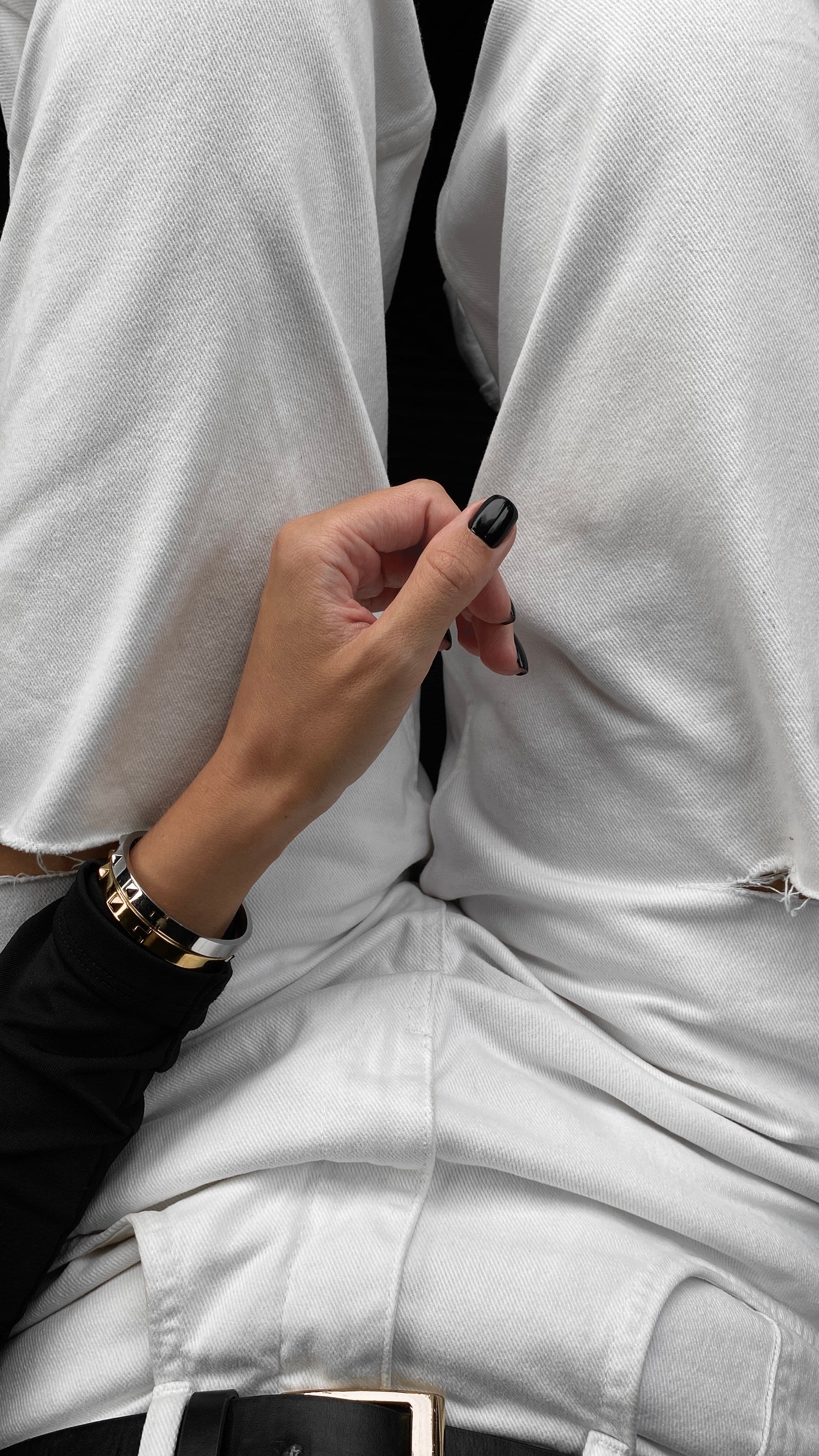
A crisp white shirt, half tucked, sleeves pushed up. A fine cashmere knit over a pair whose knees have faded to the colour of chambray. A silk blouse, which looks better with something worn-in beside it than with another polished piece.
Shoes should be plain: ballet flats or loafers in soft leather, broken in enough to have taken their own shape. A good leather belt does more than a logo would, and the belt loops on a vintage pair were built for one. On top, a structured wool coat. The contrast between tailoring and old denim makes both look intentional.
Vintage Levi's style is mostly a matter of leaving things out: no western details, no matching washes, no distressing on top of distressing, no logos. Let the denim be the one thing in the outfit that has clearly been lived in.
Finding the Pair That Feels Like Yours
Start with how the jeans feel on, not what the label says.
Size. Ignore the number on the tag. Vintage jeans have been washed, worn and sometimes shrunk, sizing has varied by decade, and non-stretch denim fits closer than modern jeans, so you may need to go up a size or two. Measure a pair that fits you well, laid flat, and compare it with the measurements a seller gives you for the waist, seat, rise and inseam.
Rise and leg. The rise is the distance from the crotch seam to the top of the waistband, and it decides where the jeans sit on your body. The leg shape decides everything below. These matter more than the model number. If you have to choose, fit the widest part of you, the hips and thighs, since a waist can be taken in.
Fabric and fading. Look for denim that's soft but not thin. Hold the seat and thighs up to the light: pale is fine, see-through is not.
Condition. Check the crotch and inner thighs, the pocket corners, the fly buttons and the hem. Small repairs are usually straightforward. Widespread thinning isn't. A mended knee is part of a pair's history; a fabric that's giving way is a different matter.
Try them on. Sit, bend, walk. Vintage denim doesn't stretch much, so if a pair is too snug at the hips, move on to the next.
And don't buy something purely because it's labelled vintage. A label tells you a pair's age, not whether it suits you. The pair worth having is the one you'd put on tomorrow.
Buy Them Once, Wear Them for Years
A wardrobe doesn't need many pairs of jeans. It needs one or two that you reach for without thinking, and enough time to let them change.
The value isn't in the acquiring. It's in the repetition: the same jeans worn until they know where you bend and what you carry, mended when they need it, washed sparingly, and kept. It's the same principle behind a smaller, more considered wardrobe, where wear is welcome and things are kept long enough to become recognisably yours.
The Pair That Becomes Yours
You can buy jeans that are already old. You can't buy the years you'll put into them.
A vintage pair arrives with a history that has nothing to do with you: someone else's knees, someone else's habits, a hem taken up for a different pair of legs. For a while it stays theirs. Then, without any particular day to point to, it begins to change. The seat softens to your shape. The pockets crease around whatever you always carry. A pale line appears where you always lean.
That's the moment it stops being a pair of vintage Levi's and becomes simply your jeans.
Frequently Asked Questions
Are vintage Levi's better than new Levi's?
It depends on what you value. Vintage pairs can offer denim that has already been worn into something soft, details from earlier production, and wear no factory quite reproduces. Modern pairs offer consistent sizing, known condition and current fits, and Levi's still makes the 501. Neither is automatically the better jean, and an old pair isn't technically superior just because it's old. The better one is the one you'll wear.
Why do vintage Levi's look better with age?
Denim that gets better with age does so because indigo sits on the outside of the yarn and wears away with friction, revealing paler cotton beneath. Over the years the knees, thighs, seat, seams and pockets fade according to how the jeans were worn, and the fabric softens too. The result is individual rather than applied. Not every fade is flattering, which is why condition and pattern are worth looking at.
What makes vintage Levi's different?
Age, mainly, and what comes with it: construction details that changed across the decades, denim that has already been washed and worn, fading you can't buy new, and cuts with different proportions from current ones. Each pair has also had a previous owner, whose habits are recorded in the fabric.
How can you tell if Levi's are vintage?
By collecting several clues instead of relying on one. The red tab (lettered in capitals before 1971), the care label (a legal requirement for US-made clothing from 1971), the patch at the back waistband, the stamp on the top button, the stitching, a selvedge edge on the outseam and the country of manufacture can all help. None is conclusive on its own: patches wear off, hems are replaced, and even collectors' guides acknowledge exceptions. If the exact date matters, ask a specialist.
What are vintage Levi's 501s?
The 501 is the riveted jean at the centre of Levi's history. It descends from the waist overalls that Levi Strauss and Jacob Davis began making after their 1873 riveting patent, and it was numbered 501 around 1890. A vintage 501 is an older pair of that model, usually straight in the leg with a button fly, though the cut, details and denim changed over the decades.
Are 90s Levi's worth buying?
Sometimes, and it depends on the pair. 90s jeans from Levi's are interesting because they sit close to the decade's relaxed silhouettes, and many were still made in the United States, but washes and cuts vary widely. Before buying, go by measurements rather than the tag, look closely at the fabric at the crotch, inner thighs and hem, check that the fly buttons work, and if you can, look at the pair in daylight. If you'd wear it, it's worth it. If you're buying the label, it isn't.
How should you wear vintage Levi's?
Simply. Vintage Levi's jeans work best with a white shirt, a fine knit or a silk blouse, plain ballet flats or loafers and a good leather belt. Let the denim be the relaxed element and keep everything around it quiet. Leave out western styling, more distressing and logos.
How should you care for vintage denim?
Wash less. Levi's suggests washing jeans after about ten wears at most, and spot-cleaning in between. When you do wash, turn them inside out and use cold water, a gentle cycle and a mild detergent, then air-dry away from direct sun and heat rather than tumble drying. Go gentler still with old pairs: check the seams and any thin areas first, and hand wash if the fabric feels fragile. Mend small tears early. And when jeans are actually dirty, wash them.
Keep this one
Save it to Pinterest.
Share this story
Things worth noticing
A note from Twenty Acres, occasionally. New stories, beautiful things, and the details we're keeping.