
Why We Still Keep Things That Need Looking After
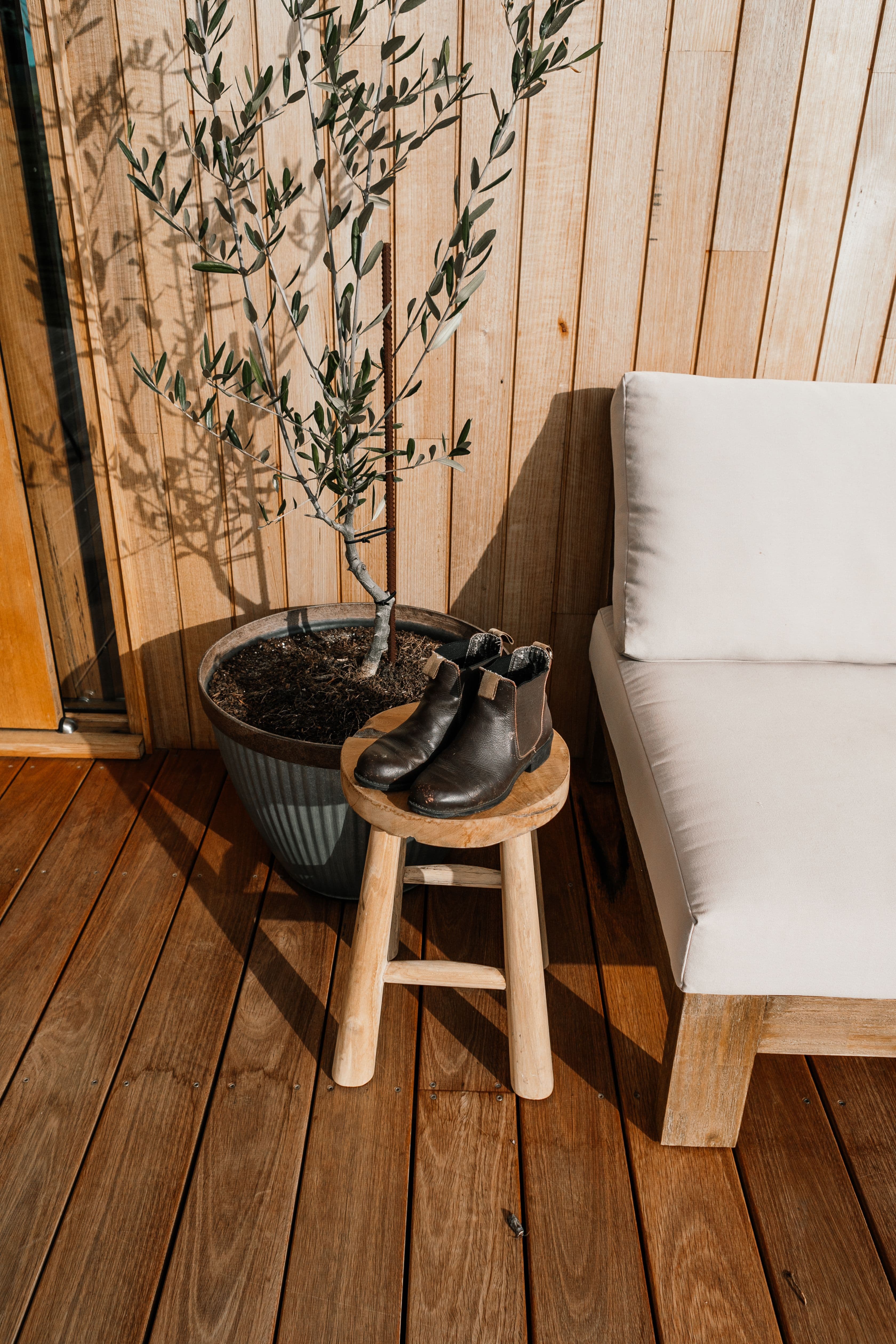
A pair of boots stands by the back door, still wet from the morning. The mud has begun to dry in pale patches, there is grass caught where the sole meets the upper, and a dark tide mark has come up the leather around the ankle. Later, someone will knock them together on the step, brush off what comes away, wipe them over with a damp cloth and stand them somewhere slow to dry, well away from the heater. It takes about five minutes, and nobody thinks of it as a task.
These boots aren't pristine, and they aren't meant to be. Some of the most satisfying things we own are not the perfect ones. They are the ones that need something from you, and they tend to be the things we are most attached to.
Things That Ask Something of Us
A garden can't simply be owned. Left alone for a season, the roses go leggy, the beds fill with weeds and the path disappears under leaves. A horse can't simply be admired: it has to be fed, and checked over, and have its feet picked out. Leather can't be worn for years without a little care, or it dries out and can crack. An old house can't be left alone either. There is a gutter to clear, a sash that sticks, a board on the verandah that has started to lift, a tap that needs a new washer.
With things like these, ownership isn't a single event at the till. It carries on for as long as you keep them, in small amounts of attention. A thing that asks nothing of you is easy to own, and easy to overlook. A thing that asks a little tends to stay close.
The Boot That Gets Better Because It Is Used
A pair of good leather boots can be bought for the way they look. They can be worn to lunch, and to the market, and kept clean, and there's no harm in it. But a boot worn for the look of it and a boot that has become part of someone's routine are, after a couple of years, two different objects.
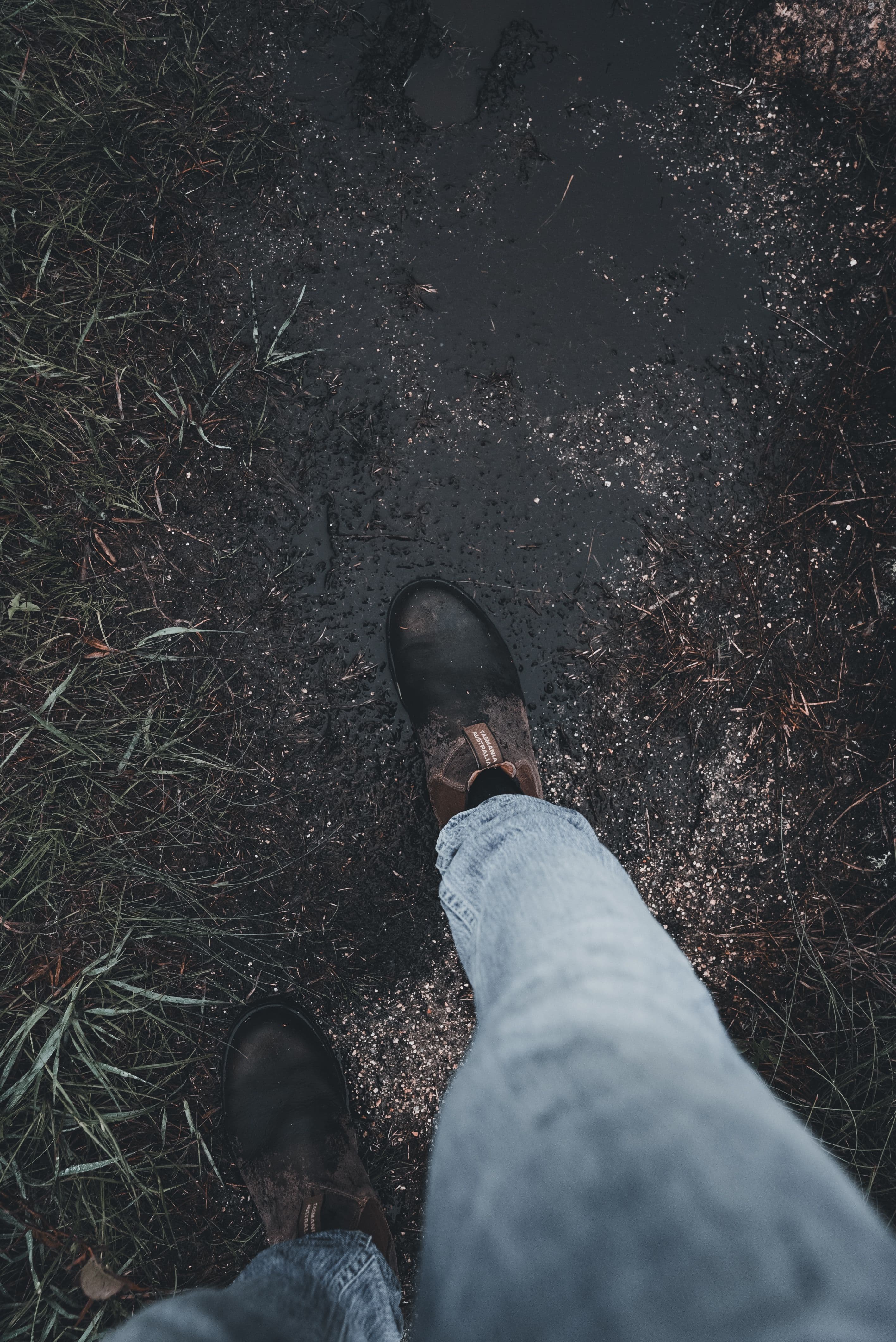
Take a pair of R.M.Williams boots, the familiar Australian leather boot with its elastic sides, and a pair of Hunter wellingtons (gumboots, in Australia), which are its opposite in material and temperament: rubber instead of leather, pulled on at the door for the wet and the mud. Both are simply things made to be used, and both show it.
A leather boot in use takes on the shape of the foot inside it. Creases form across the top where the foot bends and settle into the same place every time. The toe scuffs. The heel wears down on the outside, because of how its owner stands. There is a tide mark after a wet day, a brush and a polish on a Sunday, and, eventually, the day it needs a new sole. A rubber boot keeps its own record: the mud dried into the tread, a scuff on the toe from the gate that never quite swings clear.
What a boot in use has that a boot in a box doesn't is familiarity. You know how it feels at nine in the morning, and how it feels wet through at five. You know which side has begun to wear. It becomes one of the things you stop noticing, which is about as much as anyone can ask of a boot.
Rain Changes Everything
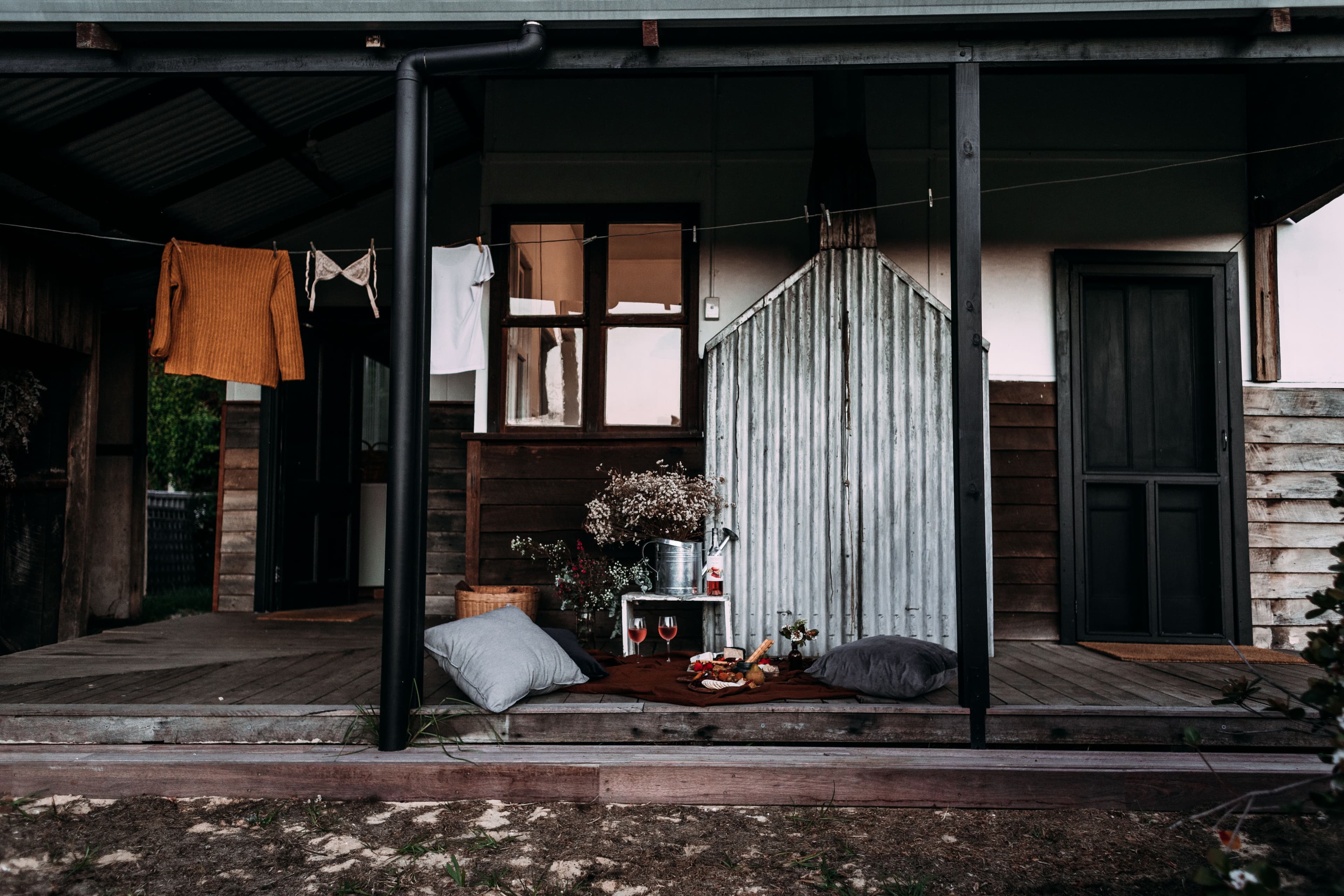
Rain rearranges a day. Where it is scarce it is an event, and where it is common it is a season, and either way it decides what you wear and where the day goes. The coat comes down from its hook. The walk to the shed that took two minutes now involves a detour around the worst of the puddles. At the back door there is a towel on a hook, for the dog, for hair, for hands, and only the dog objects. Hems are wet to the knee, and boots leave prints of mud on the boards that someone will mop later. Clothes go on the airer by the fire, or on the verandah rail once it clears, and in a wet week the house smells faintly of damp wool. None of it is glamorous, and all of it has a feel that no amount of styling can produce.
A rain jacket belongs to this: the one that hangs by the door and goes on without thought when the sky turns, slightly stiff at the cuffs and darker across the shoulders where the wet has got in. A waxed cotton one can be re-waxed when the weather starts to get through, which is a job for a dry Sunday. The point isn't the specifications. It's the working relationship between a person and the weather, and the clothes that stand in between. Rain is a fair test of what you own.
And afterwards, the garden: leaves lying thick and damp under the trees, the soil dark, the roses beaded, the paths shining, everything a shade greener by the end of the week than at the start. The weeds are ahead of everything else. Rain gives a place its mood and its list of jobs at the same time.
The Garden Is Never Finished
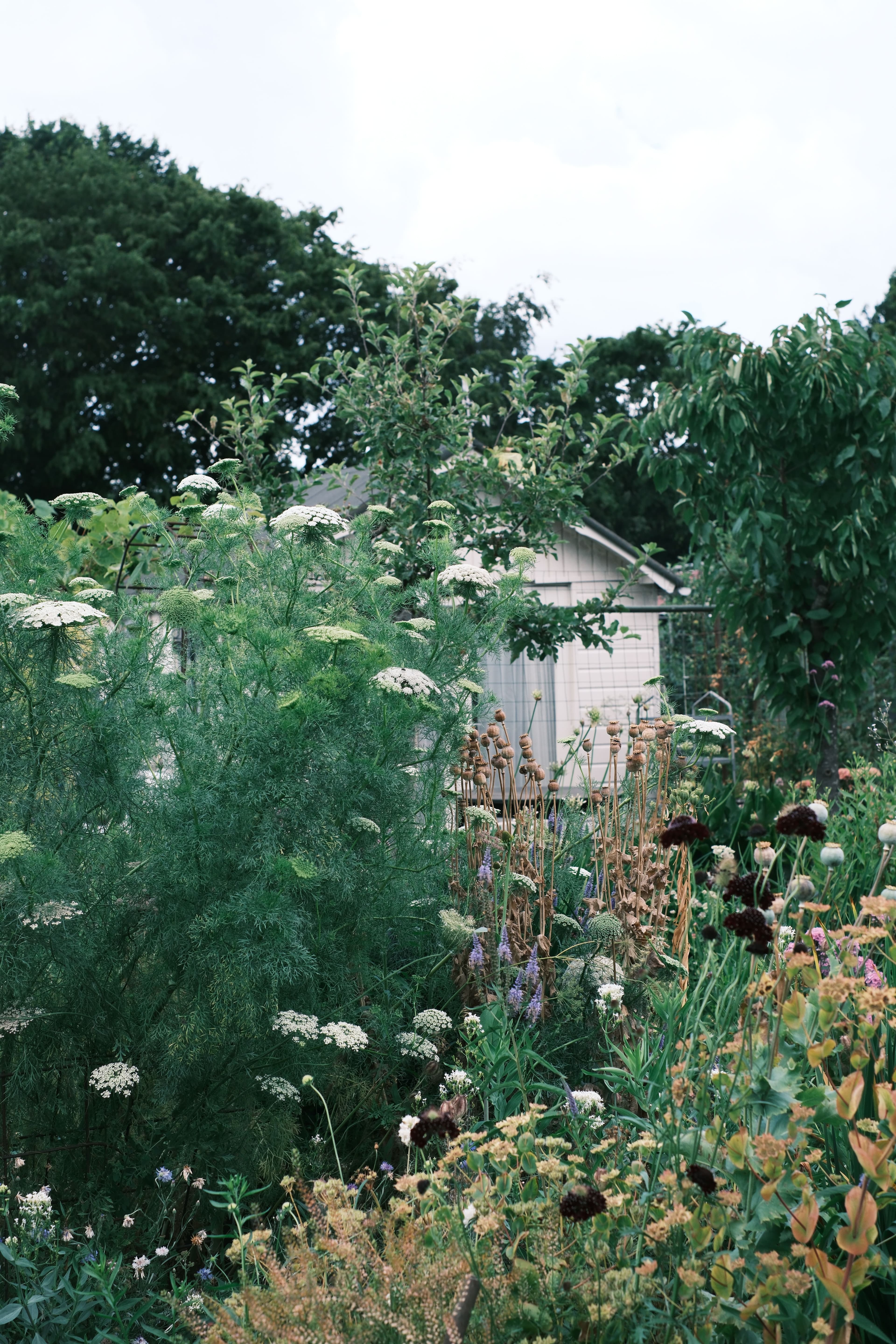
A garden is appealing partly because it refuses to be completed. There is always something slightly out of place: the rose that wants pruning, the bed that has gone over, leaves to be swept from the path, a corner that has quietly become a nursery for weeds. Even in a good week, when everything has been done, something has already moved on. There is new growth on the hedge, a pot that has dried out, the herbs going to seed.
The tools are small, and used daily: secateurs, a trowel with a worn handle, a bucket, gloves gone through at the thumb and first finger, a wheelbarrow that is always slightly in the wrong place. Cutting flowers for the house counts as maintenance too, and so does picking herbs for dinner and clearing leaves. It is an ordinary cycle of taking things out and putting things in.
A finished garden would be closer to a photograph. The garden most people are attached to is the unfinished one, where a walk round in the morning with a cup of tea turns up three small jobs and takes an hour, and doing one of them feels like a fair use of the time. The tea is found cold on a fence post at the end of it. There is an attachment that comes from having pruned a particular rose, from having watched it come back, and from having a view about what it will do next. You only get that by coming back to it.
The Pleasure of Routine
Some of the oldest pleasures are repetitions: feeding, brushing, checking, cleaning, preparing and putting things away, in about that order, day after day. A horse is fed, has its feet picked out and the mud brushed from its coat, and has a hand run down each leg to see whether anything is different from yesterday. Its rug goes on or off as the weather asks. Afterwards the brush goes back into its box, the bucket back on its hook, the gate is latched, and the saddle and bridle are wiped over and hung up.
Horses are only one part of it. There are hens to be let out and eggs to be found, some of them found later than others, a dog to be walked, a trough to be checked. What the routines share is that they don't ask you to decide anything, and the animals have no interest in whether you're in the mood. There is something steadying in that. The day begins with something that has to be done, and once it is done, the day has started.
Routine and familiar objects go together: the same brush, the same bucket, a halter softened by hands, a gate that needs a certain lift before it will latch. The objects are what the routine is made of.
The Things That Can Be Mended
Some older objects seem to ask a little more of us than newer ones, and to give something back for it: leather that has been oiled for years, a wooden handle worn smooth, a basket with a mended handle, a spade that has been re-handled twice, a table sanded and oiled after a summer of wet glasses, a fence that has never been built once, only restrung and re-posted over the years.
Not everything old is well made, and not everything new is disposable. But a broken thing can prompt more than one response. One is to get another. The other, with some things, is to clean it, repair it, polish it, mend it, keep using it.
Part of the reason may be that many of these things can be looked after. A worn handle can often be sanded and oiled, a blade sharpened, a strap restitched, a basket mended. Materials like these tend to show you what is wrong with them. Something cracked, dry, blunt or loose asks to be dealt with, and if you can deal with it, the object goes back into use, a little better known than before.
This is what choosing well-made things can mean in practice: choosing things that can be looked after, and that often improve for it. It may also be why so many of the things that last are plain.
The Point of Looking After Things
There is such a thing as pointless maintenance: polishing what is never used, keeping something perfect for the sake of it, upkeep that exists only to protect a surface. Looking after something you actually use is different. Polishing boots after rain. Cleaning the secateurs after a day's pruning. Brushing a horse. Re-oiling a table. Mending a thing instead of replacing it.
These are small acts, and they slow the relationship between an object and its owner down. You end up looking closely at things you would otherwise only use: the split beginning in the leather, the sap dried on a blade, the dull patch on the timber. Attention of that kind is how attachment happens, though it rarely feels like anything at the time.
It isn't always pleasant. Maintenance is often inconvenient, dirty and dull. The boots stay in the corner, muddy, until Sunday. The horse still needs feeding on the morning the rain is coming in sideways and there is no charm in it whatsoever. The secateurs go back into the shed with sap still on the blades, and the next job is a little harder for it. Some weeks it is a chore and nothing else, and that is allowed.
What keeps it from being only a chore is the thing being looked after: something you use, and would miss. The satisfactions are small and mostly retrospective. A pair of boots that comes up well, a blade that goes through a stem cleanly, a door that shuts. They are the private evidence that something has been looked after, and that it was you who did it.
Boots by the Door
By evening the boots have dried by the door, brushed and wiped over. The toe has a new scuff, and the leather at the ankle carries a line that wasn't there last winter. Tomorrow they will go out again.
A life becomes visible in what needs looking after: the muddy boot, the worn leather, the garden waiting to be pruned, the old house that needs another small repair. These are the things that carry the days in them, and they are often the things we know best, because we have had to keep coming back to them. The things that require attention are often the things that become part of our lives most deeply.
Perhaps the point isn't to own things that never change. Perhaps it is to have things worth looking after.
Keep this one
Save it to Pinterest.
Share this story
Things worth noticing
A note from Twenty Acres, occasionally. New stories, beautiful things, and the details we're keeping.