
The Case for a Sauna at Home

There is a particular kind of room that asks nothing of you except that you walk into it. No itinerary, no appointment, no drive across town with a towel on the passenger seat. You open a door, the heat is already there, and the rest of the evening can wait outside it for twenty minutes.
That is the real difference between going to a sauna and having one. A public sauna is a destination, and destinations require planning: a booking, a bag, a decision to leave the house at the exact moment leaving it is the last thing you want to do. A sauna at home removes the planning and leaves the room. It can be used after a run, before dinner, on a Tuesday for no reason at all, or on a winter evening when the temptation is to stay under a blanket. The sauna does not care which of these it is. It only asks to be entered.
This is not an argument that every house needs one. It is an argument about what changes when heat, bathing, cooling and quiet stop being something you travel for and start being something the house already contains.
A Sauna Is More Than a Hot Room
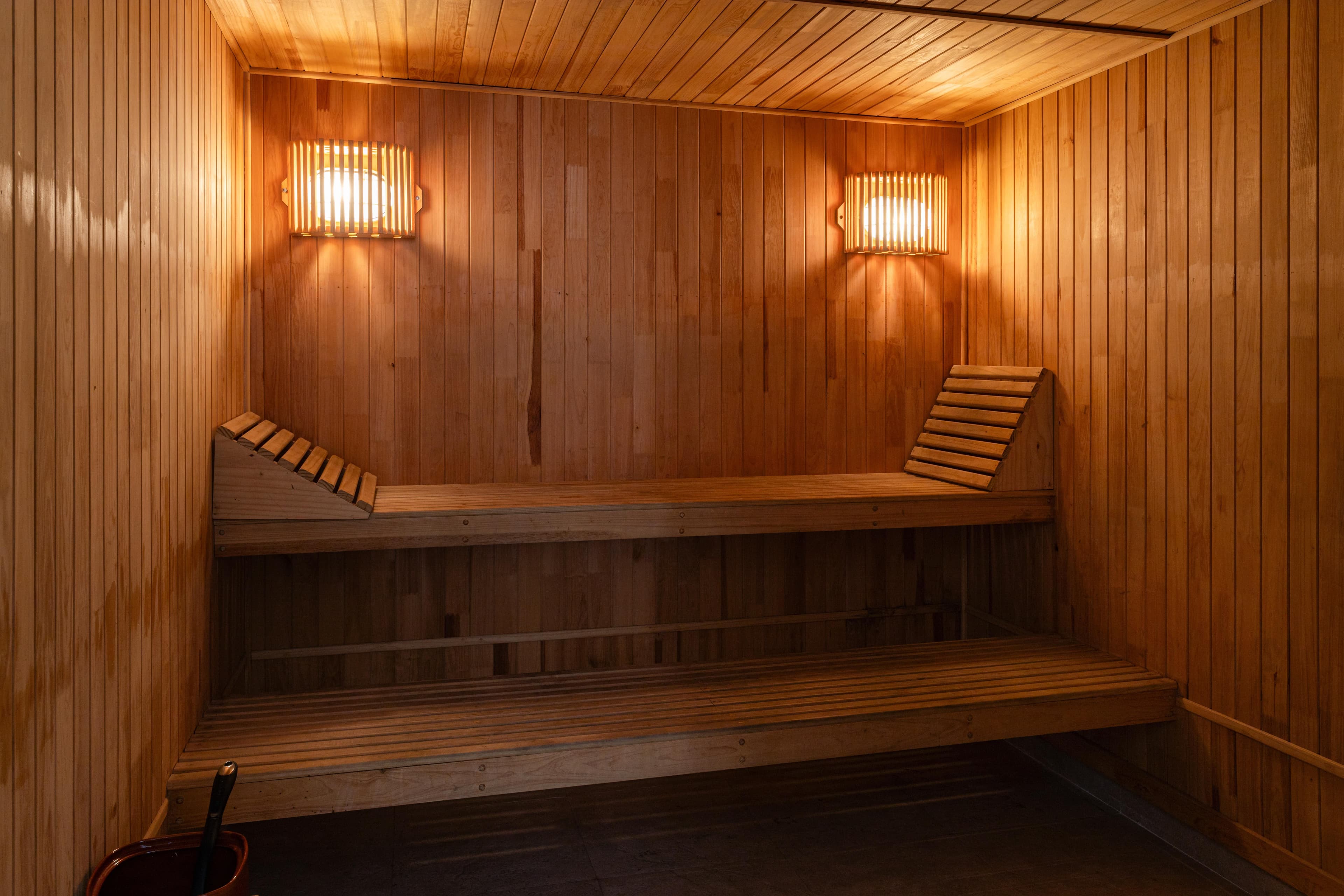
Reduce a sauna to its function and it sounds almost dull: a small room, heated, sometimes with stones, sometimes without. That description is accurate and tells you almost nothing about why people keep one.
What a sauna actually offers is a sequence. Heat first, building slowly rather than arriving all at once. Then sweat, and with it the strange, unhurried patience the body adopts once it accepts that nothing is going to happen quickly. Then cooling, which is its own pleasure and arguably the point the whole ritual has been building towards: a shower, cold air, a plunge if the house runs to one, or simply standing still while the skin remembers how to be cool. Then, if there is time, doing it again.
None of that requires a spa, a resort or a subscription. It requires a room built for heat and a willingness to sit in it. The sauna's appeal is not really the hot part. It is the whole shape of the ritual, heat and cooling held together, and a home is a perfectly reasonable place for that shape to live.
What Finnish Sauna Culture Teaches Us
It is tempting to treat sauna as a recent import into wellness, something that arrived alongside cold plunges and infrared mats. The history says otherwise.
In 2020, UNESCO inscribed sauna culture in Finland on its Representative List of the Intangible Cultural Heritage of Humanity. UNESCO's description treats sauna as integral to the lives of the majority of the Finnish population, present in homes and in public places, and concerned with a good deal more than washing. Central to the experience is `löyly`, the steam released when water is thrown onto heated stones, along with electric, wood-heated, smoke and infrared forms of the practice. The knowledge is passed down through families as much as through clubs and universities, and UNESCO itself describes Finland, at the time of inscription, as having approximately 3.3 million saunas for a population of about 5.5 million.
The Finnish Sauna Society, founded in 1937, describes its purpose as studying sauna, promoting it abroad, improving its quality and protecting its traditions. That framing matters. Sauna, in this context, is not a single hot room performing one fixed ritual. It is a body of customs, knowledge and practice, varied across families and regions, that happens to centre on heat.
None of this makes a Finnish sauna the only correct version, and it would be a mistake to claim the practice was invented by any one culture or that every sauna tradition follows the same script. What it does is place the modern home sauna inside something older and slower-built than a wellness trend. The room in a Sydney basement or a converted shed is a distant relative of something worked on, domestically and communally, for a very long time.
Traditional Sauna, Infrared and the Question of Heat
Anyone building a home sauna will eventually face a choice between traditional and infrared, and the debate around it is louder than it needs to be.
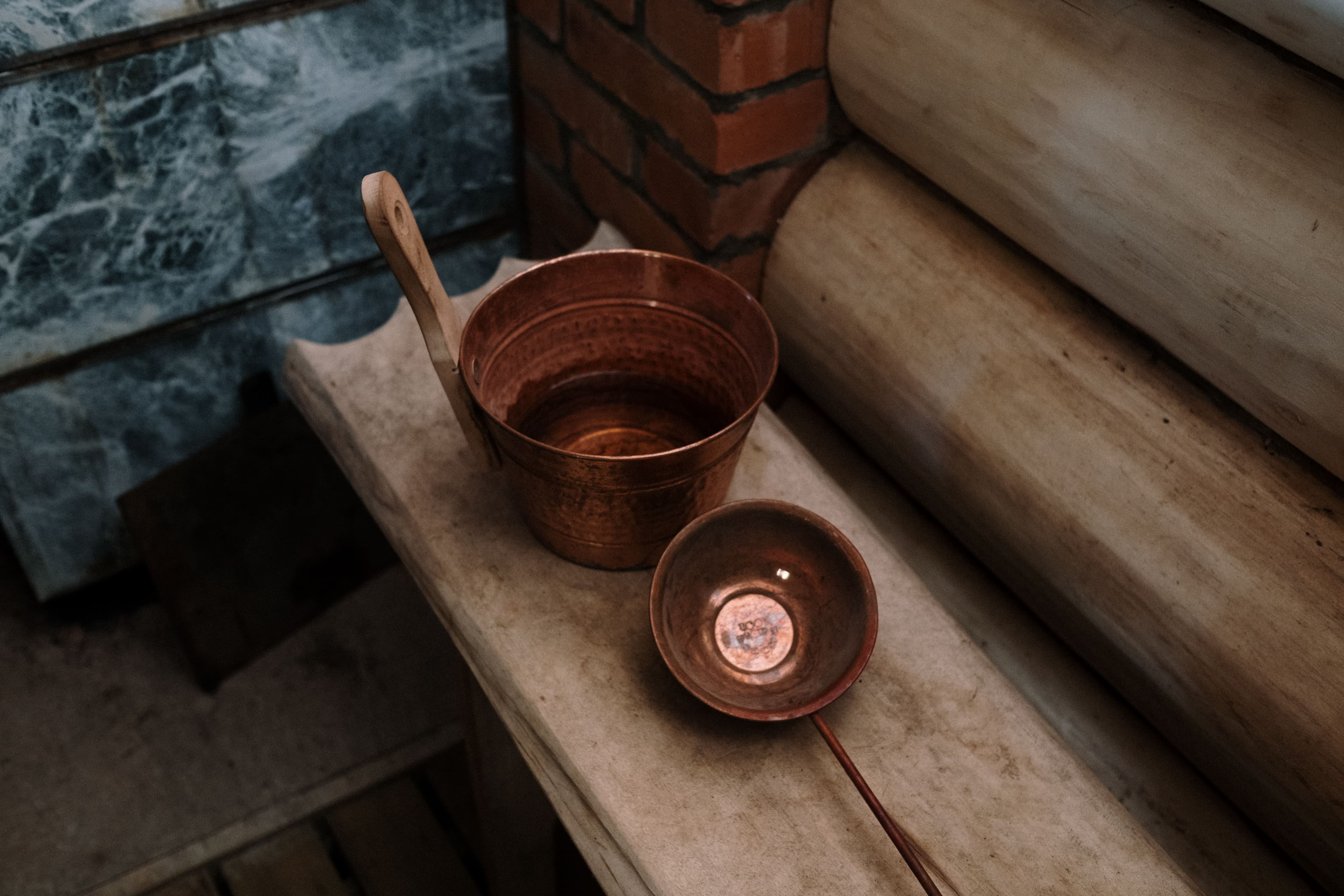
Traditional Finnish-style sauna works through the air. A heater warms stones, the room reaches a high ambient temperature, and water thrown on the stones produces `löyly`, the burst of steam that is central to the Finnish experience of the ritual. Infrared saunas work differently, heating the body directly with infrared radiation rather than heating the surrounding air to the same degree, which generally means a lower ambient temperature and a different physical sensation.
A 2025 study in the American Journal of Physiology-Regulatory, Integrative and Comparative Physiology compared hot-water immersion, traditional sauna and far-infrared sauna in twenty healthy adults: three ten-minute traditional sessions at 80°C against a single forty-five-minute far-infrared session at 45 to 65°C. It found different thermoregulatory and cardiovascular responses between the modalities, with far-infrared producing the smallest rise in core temperature of the three. A separate randomised crossover trial, run in Brisbane in 2022 with ten healthy women, found that infrared sauna did produce measurable thermal responses, but not significant differences in blood pressure, arterial stiffness or heart-rate variability compared with the exercise and control conditions in that study.
None of this settles the question of which is better, because it is not really that kind of question. Traditional sauna carries the stronger cultural connection to Finnish practice and the particular experience of `löyly`. Infrared runs cooler, works differently in the room and produces a different physical response. Choosing between them is closer to choosing a climate than choosing a winner.
What the Evidence Actually Tells Us
Sauna sits at an unusual intersection of very old tradition and quite recent research, and the research deserves to be treated carefully rather than quoted selectively.
The most frequently cited study is a large prospective cohort of Finnish men, published in JAMA Internal Medicine in 2015, linking more frequent sauna bathing to lower risk of sudden cardiac death, fatal coronary heart disease, fatal cardiovascular disease and all-cause mortality. It is worth being precise about the kind of study this is: observational, tracking existing habits and outcomes rather than assigning sauna use to one group and not another. That design can show an association. It cannot, on its own, show that sauna caused the difference.
The randomised evidence is considerably more mixed. A 2022 trial of forty-seven sedentary adults with cardiovascular risk factors found that adding fifteen-minute post-exercise sauna sessions over eight weeks produced additional gains in some measures, including systolic blood pressure and cardiorespiratory fitness, compared with exercise alone. A 2023 trial of forty-one adults with stable coronary artery disease used four sauna sessions a week for eight weeks and found no improvement in the main vascular outcomes examined, arterial stiffness, endothelial function and blood pressure, though the body did show other signs of heat acclimation. A 2025 systematic review of twenty randomised trials of passive heating found no significant pooled effect on most cardiometabolic and vascular outcomes, though it also noted a possible reduction in systolic blood pressure in some systemic-heating analyses, alongside considerable heterogeneity between the trials reviewed. A further 2025 trial of thirty-eight participants, testing exercise plus post-exercise sauna against exercise alone and a control group, found no additional statistically significant improvement in heart-rate variability.
Sauna, in short, produces a real physiological response to heat, and large observational studies have found associations between more frequent sauna use and certain cardiovascular outcomes. The controlled trials built to test cause and effect are less conclusive, ranging from modest benefit to none. None of it supports claiming that sauna prevents heart disease, extends life, detoxifies the body, replaces exercise, burns meaningful fat or guarantees better sleep. Heat is not exercise wearing a different name. It is its own thing, and the honest account of it is more interesting than the exaggerated one.
When the Sauna Becomes Part of the House
The question worth asking before any product decision is architectural: what makes a sauna belong to a house, rather than sit inside it like an appliance someone forgot to plug in properly.
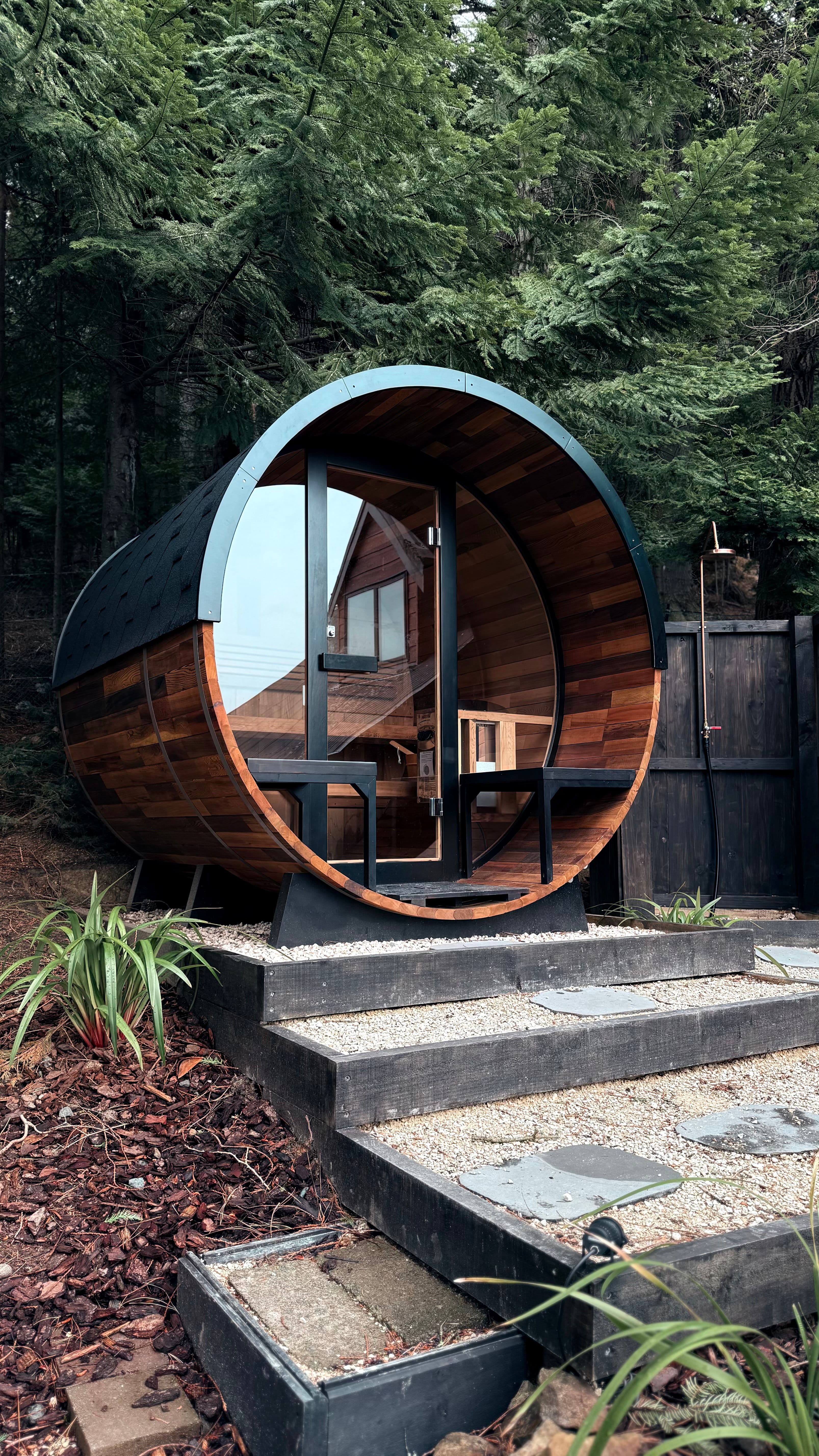
Placement decides more than people expect. A sauna near a bathroom or shower keeps the cooling stage of the ritual close at hand, which matters more than it sounds: the walk from heat to water or cold air is as much a part of the experience as the heat itself, and a room that makes that walk awkward undoes some of what the sauna is for. Indoors, it can sit within the existing envelope of the house, close enough to a shower that cooling is a step rather than a trip. Outdoors, whether as a garden studio or a standalone sauna cabin, it becomes its own small building, with its own relationship to weather, approach and the walk back to the house afterwards, cold air on warm skin. Neither is automatically better than the other; the right answer depends on the house and how the household actually moves through it.
A handful of manufacturers now treat the sauna as architecture rather than a boxed unit. Harvia builds custom indoor, bathroom and outdoor installations; KLAFS designs bespoke home saunas, including compact and made-to-measure versions; Finnleo builds custom saunas into new construction and renovation, with glass, angles, benches, timber and heater treated as design decisions. None of this is a recommendation; it simply shows how seriously the category is currently being designed, in rooms that are planned rather than assembled.
Windows and glass change the character of the room considerably, letting light in and altering how the heat behaves, which is a genuine design trade-off rather than a purely aesthetic one. Lighting, kept low and warm, can do more for the mood of a sauna than almost any other design decision. None of it is complicated to specify. All of it needs deciding before the room is built, alongside placement and the route to cooling, not adjusted afterwards.
Timber, Light, Benches and the Room Itself
The material question that actually matters is not which wood is the most prestigious. It is how the timber behaves once it has heat, water and years of use put through it.
Aspen, alder, spruce, hemlock, cedar and heat-treated timber all appear regularly in sauna interiors, each with a slightly different grain, colour and response to heat. The differences are real but they are differences of feel rather than virtue, and there is no evidence that one timber is inherently healthier to sit against than another. What is worth paying attention to instead is texture underfoot and against skin, how the wood takes on heat without burning, how it silvers or darkens with age, and whether the bench height and depth suit the way you actually sit, upright with your feet on the floor or stretched full length along it.
Light matters almost as much as timber. A single warm, low source, positioned so it never sits directly in a sightline, can do more for the room than an excess of glass or finish. A sauna lit like a bathroom feels clinical. A sauna lit like the last hour before sunset feels like somewhere worth returning to.
None of these choices are difficult on their own. What makes a sauna feel designed rather than dropped into a spare room is that they are made together, with the volume of the room, the heater and the ventilation all worked out at the same time as the finish.
The Practical Things That Cannot Be Designed Away
There is a version of sauna writing that skips straight from timber to towels, and it does readers a disservice, because a sauna is a piece of building services before it is anything else.
Ventilation sits at the centre of that. Harvia's current manufacturer guidance for its electric-heater saunas specifies six air changes an hour, with the exact supply and exhaust arrangement depending on the ventilation system and heater configuration in use. That figure applies to the systems it covers, not to every sauna as a rule of thumb; the right plan depends on the specific room, heater and installation method, and should be set by whoever is installing it, not lifted from an article.
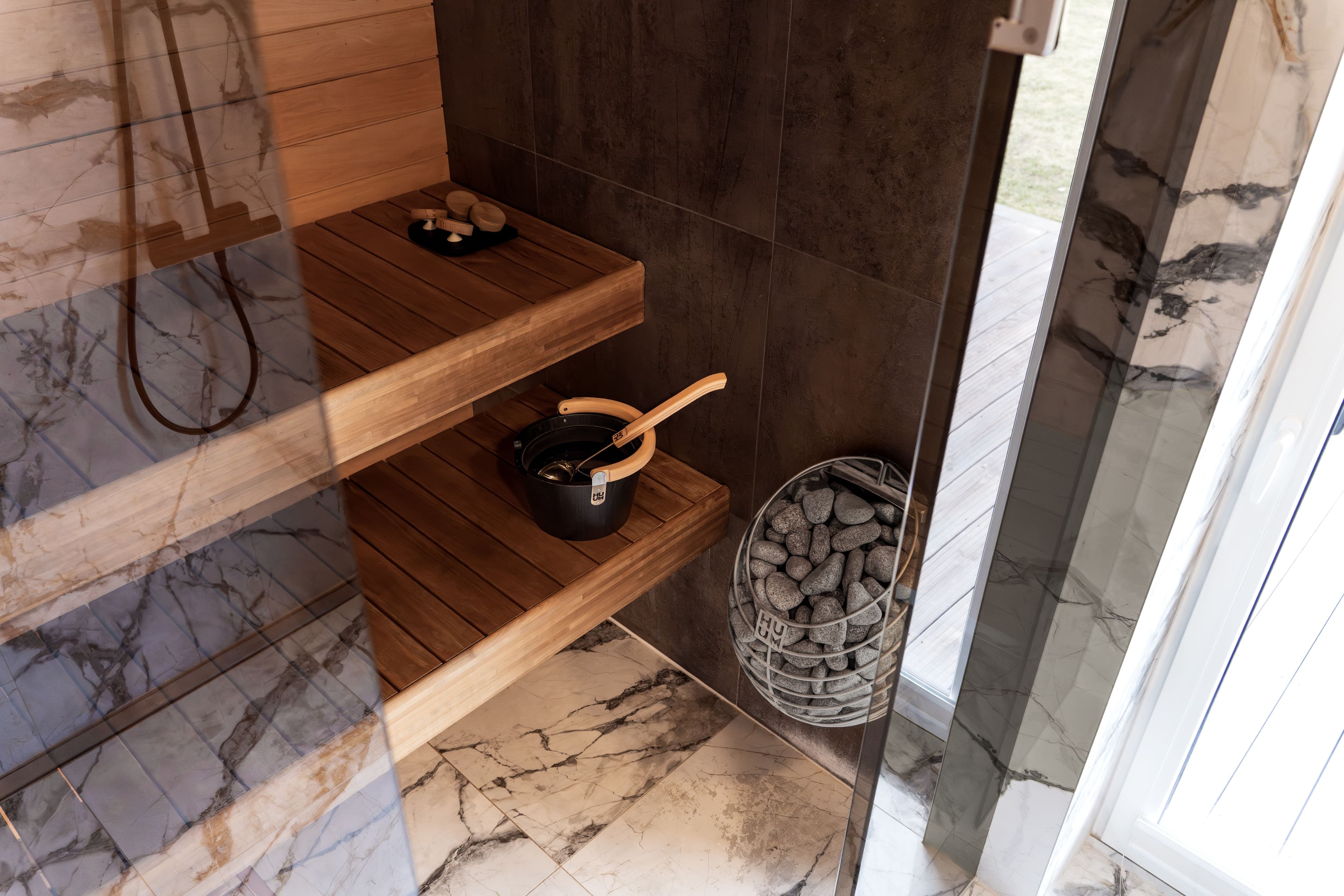
Heater sizing follows a similar logic. Power requirements are calculated from the volume of the room and its construction, and increase where there is substantial glass, brick, concrete or other material that stores heat rather than reflecting it. A heater chosen for the wrong volume will never quite deliver the experience the room was built for.
None of this is a job for a weekend and a set of instructions found online. In Australia, electrical work for a home sauna needs to comply with applicable state or territory requirements and the relevant Australian Standards, and fixed electrical work should be carried out by appropriately licensed professionals. Clearances, drainage, moisture handling and the heater's own installation instructions all need to be resolved before the room is finished, not worked around afterwards. A sauna that looks right in photographs but was built without proper regard to any of this will eventually let you know.
A brief safety note belongs here too. Sustained heat exposure is not appropriate for everyone, and anyone with a relevant medical condition, who is pregnant, or who has concerns about how their body tolerates heat should seek appropriate medical advice before using a sauna regularly.
The Rhythm Around the Heat
What actually determines whether a home sauna gets used is not the room itself but the friction around it.
A public sauna asks you to plan a visit. A home sauna asks only that you notice it is there. It might sit at the end of a morning routine, before the house properly wakes up. It might follow exercise, taking the place of the long stretch that never quite happens on its own. It might belong to late afternoon, or to the hour after coming in from the garden, still carrying the cold of outside. It might simply be the last thing before bed on a winter evening, chosen because it is easier to walk downstairs than to leave the house.
None of these rhythms is prescribed, and none of them produces a specific, guaranteed outcome; the honest claim is about ease, not about a measurable health benefit attached to any particular time of day. What changes with proximity is the likelihood of using it at all. A ritual that requires no planning gets repeated in a way that one requiring a booking and a drive rarely does, and repetition, more than any single session, is what turns a hot room into a habit.
A Room You Use Because It Is There
Most rooms in a house earn their place through obvious use: a kitchen because you eat, a bedroom because you sleep. A sauna earns its place more slowly, through a decision made again and again over months, until using it becomes part of the ordinary rhythm of the house.
That is a different kind of value to the one usually claimed for a home sauna. The room does not need to signal anything about the people who built it, or to add another feature to a list. What it needs is to be genuinely well designed and close enough to reach without ceremony. Given that, it tends to get used, and a room that gets used repeatedly settles into a house the same unremarkable way a good kitchen bench or a well-placed reading chair does.
Closing Reflection
The case for a home sauna was never really about heat. It is about the shape a house allows a life to take: whether there is a room built to want nothing more than your presence in it, a place to be quiet for twenty minutes without leaving home to find it.
A sauna does not need an occasion. That is, in the end, the whole argument. A room used on an ordinary evening for no better reason than that it is there is the kind of room most worth having.
Keep this one
Save it to Pinterest.
Share this story
Things worth noticing
A note from Twenty Acres, occasionally. New stories, beautiful things, and the details we're keeping.