
The Season Before Christmas
An Austrian Advent
When Christmas begins before Christmas
In much of Austria, Christmas is not a day. It is a season with a shape, and the shape begins four Sundays before the twenty-fifth, when the first candle is lit. In 2026 that Sunday falls on 29 November.
The emblem of the season is the Advent wreath: a ring of evergreen with four candles, one lit on each Sunday until, by the last, all four are burning. The Austrian National Tourist Office describes it as a way of counting down the weeks, and notes that a wreath once found in family homes now turns up in markets, restaurants, offices and churches (opens in a new tab). Customs differ from household to household and from valley to valley, so what follows describes what a visitor is likely to meet, not a single way of keeping the season.
The effect is a long, unhurried approach. Baking begins, and the tourist office's own list of seasonal traditions includes vanilla crescents, gingerbread and Christmas punch. Squares fill with stalls. The pleasure of an Austrian Advent is that nothing is rushed towards a single evening. You are invited to enjoy the weeks themselves.
The city after dark
Salzburg is the place to begin. Its old town sits beneath a fortress, inside a historic centre that the city's tourism board describes as a UNESCO World Heritage site, and in the weeks before Christmas it becomes a small, lit, walkable stage.
The main event is the Christkindlmarkt on Domplatz and Residenzplatz, beneath the cathedral arches. The tourism board traces its roots to a trading market on the cathedral square in the late fifteenth century, later known as the Nikolaimarkt, and gives its present form as dating from 1974. About a hundred stalls fill the squares, with a specially designed canopy of lights strung overhead like a night sky, and a programme that includes choirs, brass played from towers, readings for children and a visit from the Christkind. The market's own site, christkindlmarkt.co.at (opens in a new tab), carries the programme.
For 2026, Salzburg's tourism site gives the main market's dates as 19 November to 1 January, with shorter hours on 24 December and again on the 25th and 26th. Those details come from the official listing (opens in a new tab) as it stood in autumn 2026. As with every seasonal event they can change, so check the page before you plan around a particular evening.
What makes the market worth the journey is less any single stall than its setting. Baroque façades, a cathedral, a fortress above the roofs, the hills beyond. When the light fails, which in December is early, the squares glow, and the city does half the work.
Traditions worth understanding
Advent in Austria has older, stranger layers, and it helps to know a little before you meet them.
On 6 December comes St Nicholas, who rewards children with small gifts. The evening before, on 5 December, comes Krampus. In Austrian Alpine folklore Krampus is a dark companion to St Nicholas, a horned, fur-clad figure who, in the old stories, deals with children who have misbehaved. The regional tourist board for SalzburgerLand (opens in a new tab) is gentle about what really happens: St Nicholas and Krampus visit house to house, and the real outcome is a bag of sweets, nuts and mandarins.
Krampus is best understood as theatre rather than menace. In towns and villages costumed figures run through the streets with bells and chains, and the noise and the carved masks are part of the point. Salzburg's own calendar lists a traditional Krampuslauf at the Christkindlmarkt on 5 December 2026, a St Nicholas visit with a child-friendly Krampus on the 6th, and a Perchtenlauf on 21 December. Perchten are a related tradition of masked processions. These runs can be loud and crowded, and younger children may find them frightening, so read the listing before you go.
Not everything is loud. A short journey north of Salzburg, in the village of Oberndorf, is where the carol Silent Night was first performed, on Christmas Eve in 1818, in a church that no longer stands. A small memorial chapel marks the place. The story and visitor details are told by the Silent Night site (opens in a new tab) and by SalzburgerLand's page on Oberndorf (opens in a new tab), and it makes a quiet counterpart to the market in the city.
What to taste and bring home
The simplest way to understand a market is to eat at it. The city's description of the Salzburg market mentions regional specialities, Glühwein and punch, and among the goods tree decorations, gifts and incense. Beyond the market, the baking of the season is part of the story: vanilla crescents (Vanillekipferl) and gingerbread are both on the tourist office's list. In Salzburg itself there is Salzburger Nockerl, a sweet, airy dessert usually shared.
As for what to bring home, think in categories rather than hunting for a particular object. Tree decorations, candles, baked goods and incense are all part of the season. If a stallholder says something is handmade, or made locally, it is a perfectly reasonable thing to ask how and where. A market at this scale mixes makers and resellers, and you will enjoy it more if you do not assume which is which.
Salzburg or Vienna?
They are different experiences, and neither is the better one.
Salzburg is compact. The old town can be crossed on foot in a short time, the main market sits at its heart, and the whole place is arranged around a few squares, a river and a fortress. It suits a few days, a slower rhythm and a preference for atmosphere over scale. It is also the recommendation of this article.
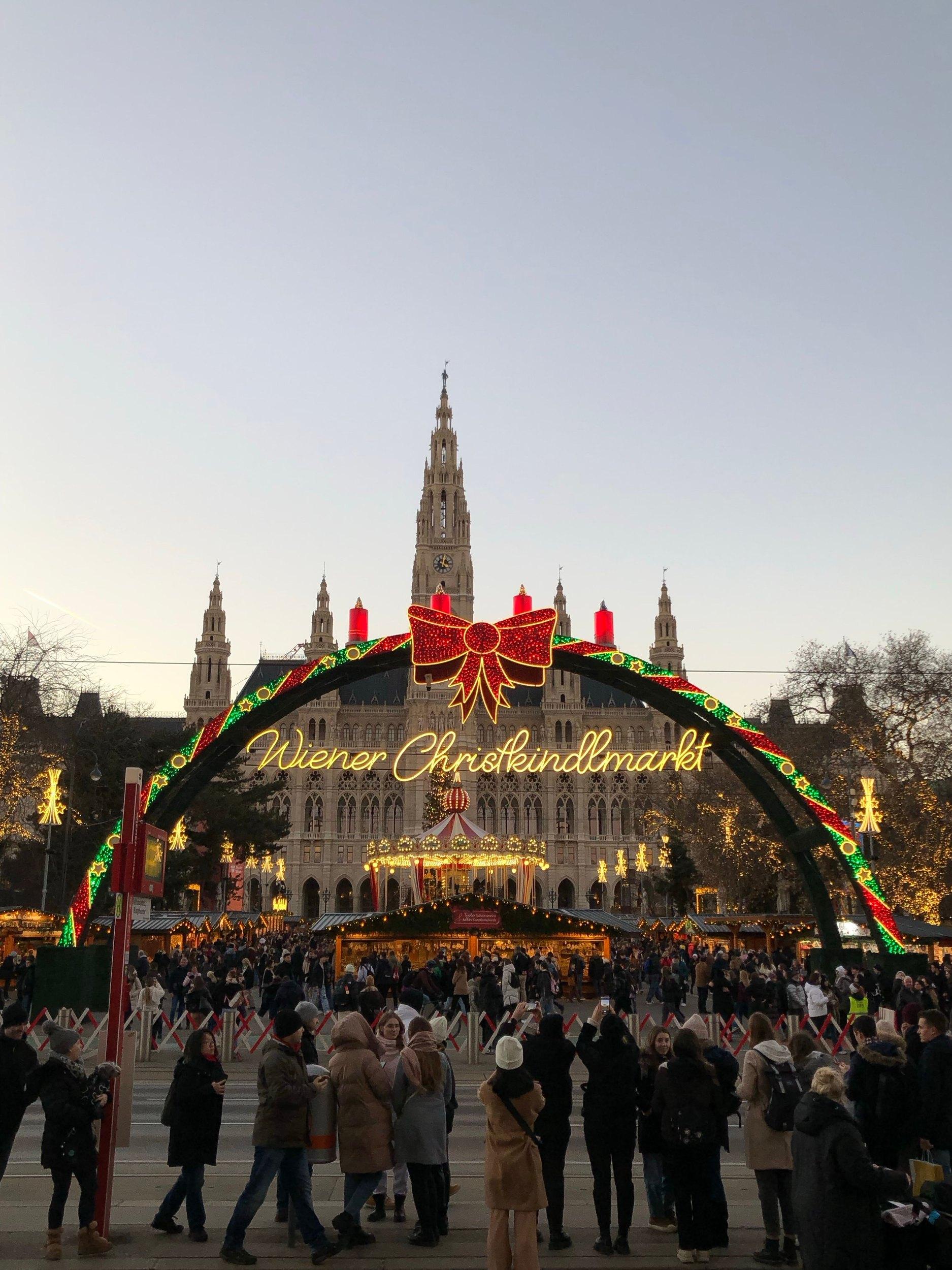
Vienna is a capital, and its Advent is on a different scale. The city's official tourism site lists a wide choice of Christmas markets (opens in a new tab) across the city. The best known is in front of the City Hall, the Wiener Christkindlmarkt on Rathausplatz (opens in a new tab), which in 2026 runs from 13 November to 26 December, daily from 10 am to 10 pm, with shorter hours on Christmas Eve. An ice rink beside it continues into January. If you are drawn to grand urban spaces, museums and a wider range of markets, each with its own character, Vienna is the better fit.
A sensible way to decide: choose Salzburg if you imagine walking slowly through one beautiful historic centre in the evening, and Vienna if you imagine a city break in which markets are one thread among many.
Where to stay
The choice is mostly between being close and being quiet.
Staying in or near Salzburg's old town puts the market, the churches and the restaurants within a short walk, and you can step back to your room between outings. The trade-offs are practical: central rooms are fewer and tend to be booked earlier for Advent, the streets are busiest in the evenings, and some historic buildings come with small rooms and narrow stairs. If you are travelling without a car, a central base makes the visit much easier.
Staying farther out, in a quieter part of the city or in the lake and mountain country beyond it, changes the rhythm. Evenings are calmer and the surroundings more rural, and some of the smaller Advent markets of the region become part of the trip. The trade-off is transport: you will rely on buses, trains, taxis or a car, and returning late at night takes a little planning.
Neither is right for everyone. A first Advent visit often suits the old town. A return visit, or a trip built around walking and quiet, may suit somewhere farther out. There is no accommodation recommendation in this article, because the choice depends far more on how you want your evenings to feel than on any single address.
Planning an Advent visit
A few points make the difference between a pleasant trip and a frustrating one.
Check the season, not last year's. Markets open and close on set dates that change from year to year. Use the official pages linked above for the current season, and be wary of dates quoted in older articles.
Early or late Advent. Late November and the first days of December see the full programme begin, with a calmer feel on weekdays. The days closer to Christmas, and weekends, are typically busier. The traditional dates of 5 and 6 December, and the Perchtenlauf on the 21st, are fixed points if the folklore interests you.
Christmas week. Salzburg's main market keeps shorter hours on 24 December, and again on the 25th and 26th, so do not assume a full evening. Shops and restaurants keep their own holiday hours.
Getting there and around. Salzburg is reached by train and road, and the old town is best explored on foot. The city's tourism site has travel information (in German) (opens in a new tab) and an events calendar, and it is worth checking timetables for the days you plan to travel.
Check before you book. Look up the specific events you care about, such as a Krampus run or a concert, before you commit to dates, and confirm that they take place in the year you are travelling.
Advent in Austria is not an event to be completed. It is a season to be entered gently, with time to wander, to taste and to notice. Come with a plan, and then leave room for the evening to surprise you.
Keep this one
Save it to Pinterest.
Share this story
The Twenty Acres Club
An archive of things worth noticing. Receive our private seasonal notes on the wardrobe, the house, travel and the small details that make a life its own.